It’s 1975. You Just Don’t Know It Yet.
Thoughts, observations, and other ramblings about AI and its impact
A Typical Morning…

Walk through your morning. Nothing fancy — just a normal day.
Alarm goes off. You shut it off, glance at the time, maybe check the weather, scroll the headlines…something about Iran. Glance at your email and your calendar while you shuffle to the kitchen. Make some coffee while you jump in the shower. Maybe throw something in the microwave before you head out the door.
Get in the car, check the traffic, fire up the podcast you’ve been listening to. Run through the drive through to get another coffee… because, why not? Tap your card to pay. Halfway to the office, your phone re-routes you around a traffic slowdown. Pull in, badge or key into the building. Sit at your desk. Check what’s already going on this morning.
Normal morning. Nothing unusual.
Now ask yourself: how much of that involved computing?
The alarm — chip inside. The weather icon you checked — pulled from satellites, radar, and forecasting models running on server farms. The headlines you scrolled — retrieved from some server across the world and routed to your phone over the global internet. Your email — computer technology end to end, from the server that held it to the client rendering it on your screen… same for your calendar. The coffee maker — chip in the timer. The water heater that fed your shower — most newer ones have electronic controls. The microwave — chip running the keypad and the cook profile.
Your car is almost all computing at this point. The ignition, the fuel injection, the brakes, the transmission, the stability system, the cameras, the audio. The live traffic check — data from cars, sensors, and algorithms you’ll never see. The podcast streaming from a server across the world, compressed on the fly. Your phone re-routing you around the slowdown — GPS satellites, real-time traffic modeling, and mapping services that didn’t exist thirty years ago. The drive-through ordering screen — networked computer. The card reader — computer. The chip on your card — authenticated across a global computer network. The badge reader at the building. The monitor on your desk. The lights and the thermostat in the office are controlled by a computerized system.
And that ignores the biggest one of all. The electricity powering every single thing I just listed. The grid delivering power into your house is routed, balanced, and protected by computer technology running twenty-four hours a day, seven days a week.
Every single thing you just did involved computing.
Now do the same morning in 1975.
Windup alarm. Newspaper on the porch — same headline about Iran, just in ink. Dial thermostat. Paper daily planner. Stovetop percolator. Cash in your wallet. Carburetor and mechanical ignition. Traffic lights on mechanical timers. Metal key in the office door. Flip on the lights and turn up the thermostat (because it’s cold in here). Paper calendar on your desk. A corded phone that only does one thing. Even the electricity came from a grid run mostly by humans flipping switches at control panels.
If you told that person in 1975 that one day — in their lifetime — they wouldn’t make it through a single ordinary morning without computing, they’d tell you you were wildly overestimating what computers were going to be.
They’d be wrong by an order of magnitude. You’re probably making the same mistake with AI, by the same order of magnitude, and for the same reason.
You might look at ChatGPT (or Copilot or Gemini, whatever you’ve played with) and think ‘this is fine, it’s kinda cool, but probably overhyped’. The same gut that told someone in 1975 that computing was kinda cool, probably overhyped.
But what you’re seeing today is not AI in its final state. It’s a preview of AI the way a mainframe in 1975 was a preview of the iPhone. You’re evaluating its usefulness on the base technology, not the final product.
The Technology isn’t the Product
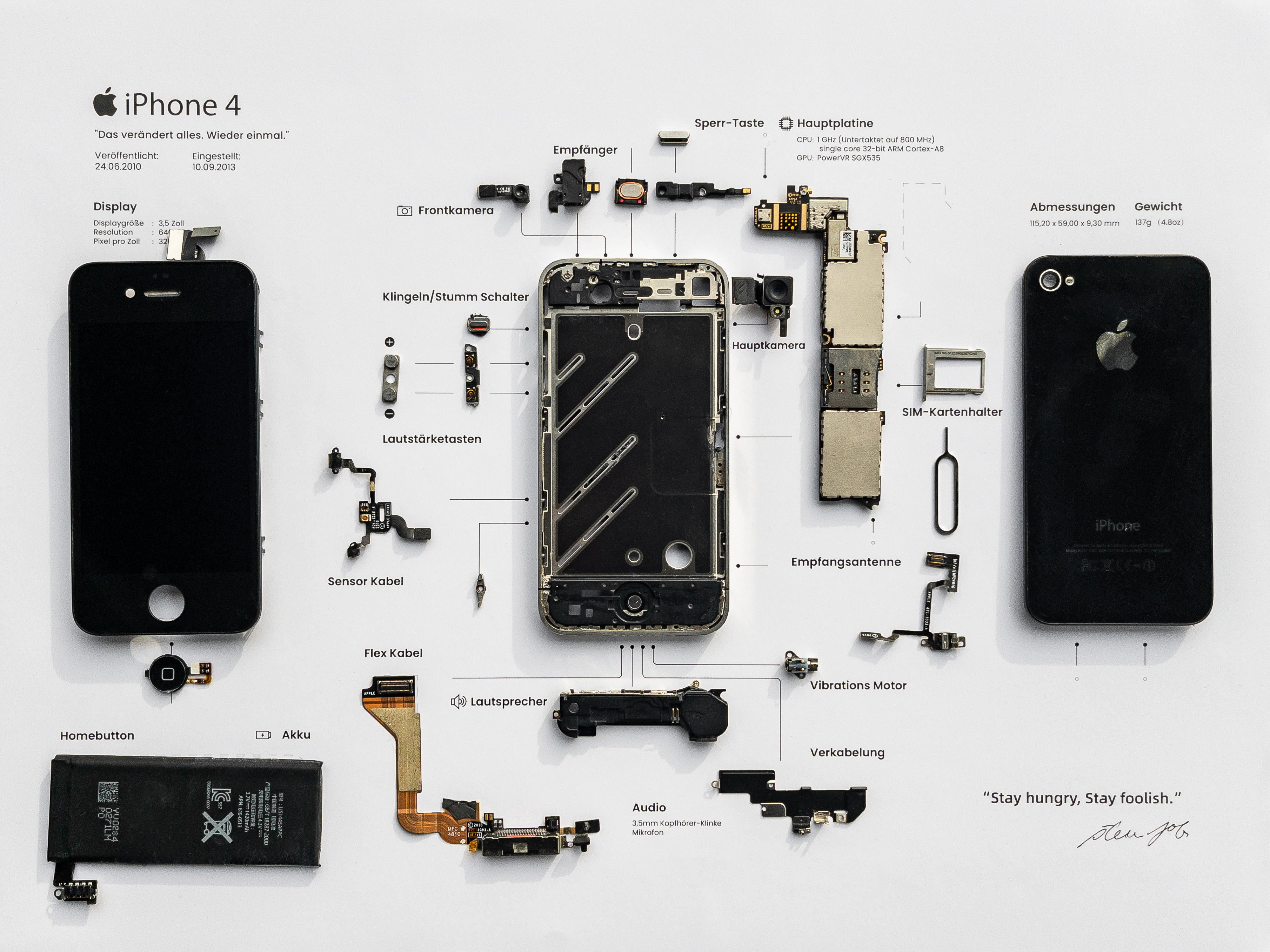
The microchip was invented in 1958 by Jack Kilby of Texas Instruments. He later won a Nobel Prize for it, but at the time, it was a non-event. There wasn’t a ‘Microchip’ product launch with slick commercials featuring a trendy song you’ve never heard before. People weren’t lined up outside of stores trying to get their hands on one. The microchip is the core piece of technology that all computers are still built upon, but in 1958, outside a small segment of the science and engineering world, I doubt anyone even noticed. It wasn’t even until 2000 that Mr. Kilby got his Nobel Prize. Why? Because the technology is not the product.
Let me explain what I mean…
Imagine I handed you the newest iMac (or iPhone, or iWhatever). Top of the line. Fastest chip Apple makes. A display with sharper resolution than most human eyes can discern. A hard drive so large you don’t even know what the letters mean. Mb -> Gb -> Tb -> Pb -> Eb -> Zb -> Yb??? A beautiful piece of hardware… But then I strip it of all the ’stuff’ that makes it useful. No operating system. No apps. No internet. No iCloud account. Nothing but the bare machine…
You now have the core technology every computer on earth is built from. A newer version to be sure — faster chip, more memory — but structurally the same technology computers have been using since the 1970s. A CPU. Memory. Storage. What more could you possibly need?
A lot. This bare iMac (or iPhone) is useless to you. You can’t write a letter. You can’t check email. You can’t watch anything, listen to anything, or save anything. All of that hardware — the core technology — is there, doing nothing, because everything that made it useful is missing.
This is where we are with AI.
The core technology — the model (LLM or neural network) — exists. It’s here. It works. What’s missing is everything that will make it useful. The AI version of an operating system. The AI version of apps. The AI version of the internet. The AI version of cloud storage. None of that has been built yet. We don’t even know what those things are going to look like.
In 1975 nobody was envisioning things like Windows, Excel, the Internet, Google, the iPhone… (OK, maybe Steve Jobs was.)
Why 1979 1975?
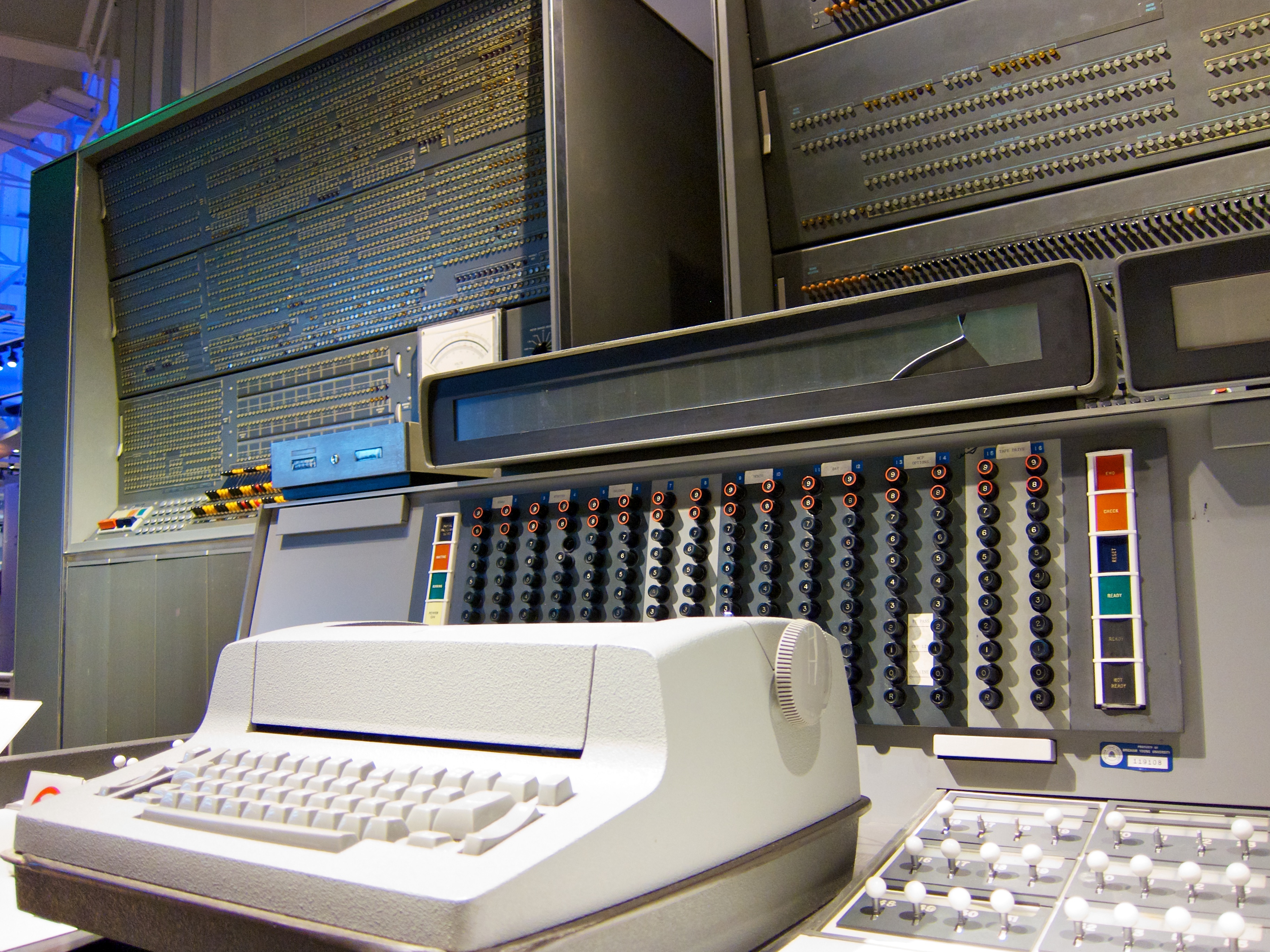
To support my argument, I created a timeline of the significant ‘events’ in the advancement of computing to date (see the left timeline). This is how we got to where we are today. If you look through that timeline, you’ll see that during most of the early days of ‘computing’, not much happened. Some early theoretical stuff, followed by technological breakthroughs that most people didn’t really know (or care) about. The progression was slow, and not always steady… and then it exploded in the 90’s and 2000’s. Early theory -> a tech foundation -> application layers added. It was 150 years in the making… And it was long after the creation of the foundational technology before enough of the supporting pieces came together in a way to meaningfully impact the daily lives of most people. Computers weren’t even a viable commercial product until the 80’s, yet by the 2000’s they had become omnipresent in our world. In 1984, only 8% of US households had a computer. Now, every 14 year old has one in their pocket hand.
On the right, I added a similar timeline of significant AI events, and I attempted to align the two timelines. It’s not an exact match, but there are similarities… early theory, large periods where not much happens. Then, some fundamental technology is developed, upon which everything thereafter is built. Based on my best guess, AI is somewhere around 1975 on the computer timeline. Which means we’ve still got the explosion of the 90’s and 2000’s ahead of us.
So why 1975? There’s nothing magical about 1975. well, except it was the year I was born So how did I determine that we’re currently in 1975? I’m glad you asked… even if you didn’t. More history lessons incoming…
In building the AI timeline, I wanted to match its events to the analogous version on the computing timeline — the theoretical concepts, the tech breakthroughs, AI’s microchip, its Internet, its iPhone moment, etc. I thought that by aligning key events, I could calculate where we are today with AI’s progression. Nerdy, I know, but I did it anyway. It didn’t need to be perfectly accurate, just good enough to reinforce the point. I thought I had a pretty good idea of where it would lead me… I was wrong… on many levels.
Some of the early stuff was a bit arbitrary. Some aligned well, some didn’t. What was really important in determining where we are now was properly aligning the later events. ChatGPT was the big one. It put AI on everyone’s radar. I decided that ChatGPT best correlated to the Xerox Alto on the computing timeline. The Xerox Alto - released in 1973 - was the first production computer with a ‘Graphical User Interface’ (GUI). It had a screen, a mouse, icons, etc. Prior to that computers required you to type known commands, but the Alto made it so the average person could operate a computer by clicking stuff on the screen. Ok, the Alto was the first computer that normal people could use… ChatGPT allowed the average person to use AI - same same. Plug 1973 into the calculation as equivalent to 2022, regenerate the timeline… boom…that puts us right about at 1979. “Perfect! My Iran reference in the opening section works in both eras. I’m so clever…”
1979? I thought you said 1975? Good, you’re still paying attention.
Ok, I had my two timelines. Everything aligned nicely. Now I just needed to fill out the remaining arguments. But something wasn’t right?.. I kept coming back to it. ChatGPT had been hugely successful, but the Xerox Alto? If you had asked the average person in 1975 about the Xerox Alto (or what a GUI even was), I assume most would’ve had no clue. ChatGPT on the other hand? How many people didn’t know about it by 2024? Perhaps in an alternate universe ‘Xerox’ is synonymous with computers, but in this universe, they’re still just copy machines. This couldn’t be right? These events didn’t align…
So where does ChatGPT fit on the timeline? My instinct (and the basis of my whole argument) was that, even though it had opened AI to the masses, ChatGPT was not AI’s iPhone moment. Was I wrong?
While I was writing a later section, I had two realizations. Which resulted in a lot of editing, and a reference to Iran that no longer worked. (I kept it anyway… maybe I’m not so clever?). What I realized was:
- My timeline was wrong - we are actually earlier than I originally thought.
- The computing timeline had nothing like the ChatGPT release because it couldn’t! The average person couldn’t interact directly with computing’s foundational technology (the microchip).
The ChatGPT phenomenon was something different.
Isn’t It Ironic? - Wait, it’s not ready yet!?

ChatGPT was publicly released by OpenAI on November 30, 2022 as a free ‘research preview’. It reached 1 million users within five days and 100 million monthly active users by January 2023. For those of you that do math as well as an LLM (<--foreshadowing), that’s only two months!
To say it exploded is an understatement. But that wasn’t actually the plan. ChatGPT was released so that people could play with it, get some real world use, and OpenAI could get some feedback. It wasn’t a finished product. It was just their latest LLM with a chatbot interface bolted on so that people could use it. It didn’t even have a real name? The ‘GPT’ just stands for Generative Pre-trained Transformer, a type of large language model. Hardly a strategically branded name created by a marketing team… And OpenAI wasn’t really that far ahead. Google could’ve released something similar. They invented much of the technology that ChatGPT was built upon. But Google didn’t release it. They didn’t think it was ‘ready’, and anything released with “Google” on it needed to be ready… a finished product. Whereas OpenAI was just an AI lab that nobody really knew much about. Elon Musk notwithstanding No one - OpenAI in particular - expected it to blow up like it did. It caught the entire industry off guard. But once it did, the genie couldn’t, wouldn’t, go back into the bottle. And since that release, every company even tangentially related to the AI space has been dealing with the conflict created by the most successful product release in history, ironically, not actually being a product. ChatGPT was basically just a demo. A demo of what the latest LLMs could do.
In 1968, a guy named Doug Engelbart, from the Stanford Research Institute (SRI), publicly demoed a mouse, clickable links, video calls, on-screen windows, shared file editing — all at once. It was later dubbed the ‘Mother of All Demos’ and considered a key moment in the history of computing. Mr. Engelbart wasn’t standing on a stage in a black mock turtleneck showing you what would be in stores in three months. He was just giving everyone a look at what could be done with this underlying computing technology. It was a pretty insightful vision, and well ahead of its time, but it was just a preview. There wasn’t a finished product ready for distribution. That wouldn’t come until many years later.
ChatGPT was AI’s version of the ‘Mother of All Demos’ (and based on its popularity, it might be the ’King of All Demos’). It wasn’t intended to be a final product. It was just a demo of the underlying tech (the LLM), and it gave people a glimpse of what was possible. So why was this demo a historical event, but you’ve never heard of Doug Engelbart’s ‘Mother of All Demos’? (I hadn’t either until I started creating these timelines.)
I think for two reasons:
- The internet. To witness the ‘Mother of All Demos’ you had to be in the room in San Francisco in 1968. To experience ChatGPT, you just needed an internet connection and a web browser.
- You could interact directly with the underlying tech…
If the foundational technology of computing is the microchip, to interact directly with it you need to know machine code and have some way of connecting to it. How many people can do that? The percentage of the population that falls into that category is pretty small, especially in 1968. Doug Engelbart’s demo was his (or SRI’s) interaction with the underlying tech and his (their) vision of the future. But to interact with the foundational technology of AI, you just needed a chat interface, an internet connection, and competency in a language (any language!). You didn’t have to experience this foundational tech through the ideas of a group of engineers and programmers in Silicon Valley - you could play with it directly yourself! This was novel. For possibly the first time since the wheel, the average person could directly interact with a foundational advancement in technology, in real time. We were all unknowingly taking part in a demo, and we all saw something in it. Think back to the first time you interacted with AI. You were probably somewhat awestruck. I know I was. It gave us a personal glimpse of the future, and we all saw it in our own way (both good and bad).
Ok, back to the timeline. By placing ChatGPT on the computing timeline in 1968, recalculating the timeline puts 2026 somewhere around 1975. You could argue my logic, or my alignment of events, and you might be right… I don’t care. I already rewrote this once, I’m not doing that again. We can just agree to disagree… However, I don’t think it’s a stretch to say that we’re somewhere between the core tech being invented and the release of the useful products that change the way we do things. The same place computing was around 1975 (maybe 1970 ~ 1980?).
So what’s my point? If you didn’t come here for a history lesson, sorry, too late. But I’m going somewhere with this, I promise… These two timelines aren’t entirely separate. They will start to converge in a fortuitous way.
Computers are Great at One Thing
A computer’s strength is also its limitation… and it’s massive. Let me explain.
Computers are phenomenal at one thing: deterministic work. What is deterministic work? It basically just means you can ’determine’ the output based on the input(s) and the rules. (A couple of years ago, I didn’t know this either.)
In other words, 1 + 1 will always equal 2.
You give computers precise inputs and rules, and they give you precise outputs. Every time. Reliably. At scale. Forever. And they’re really fast at it.
That’s the deal we’ve struck, and the computers have kept up their end. For eighty years we’ve built every piece of software on top of that consistency. Banking, payroll, factories, medical records, shipping, air traffic. Anything that ran on precise rules, computers crushed.
However, that strength was also a weakness… That ‘consistency’ could also be called ‘rigidity’. Computers don’t do well with ambiguity or interpretation. Anything that needed judgment, or inference, or “what did they actually mean” — we kinda worked around. By not allowing a computer to do it, or injecting a human into the workflow, or adding a bunch of rigid, but fragile, rules to handle all the various ‘scenarios’… and those rules constantly broke. How many times has your auto-correct changed a word to ‘duck’ when you didn’t ducking want to say ‘duck’? Is that just me?
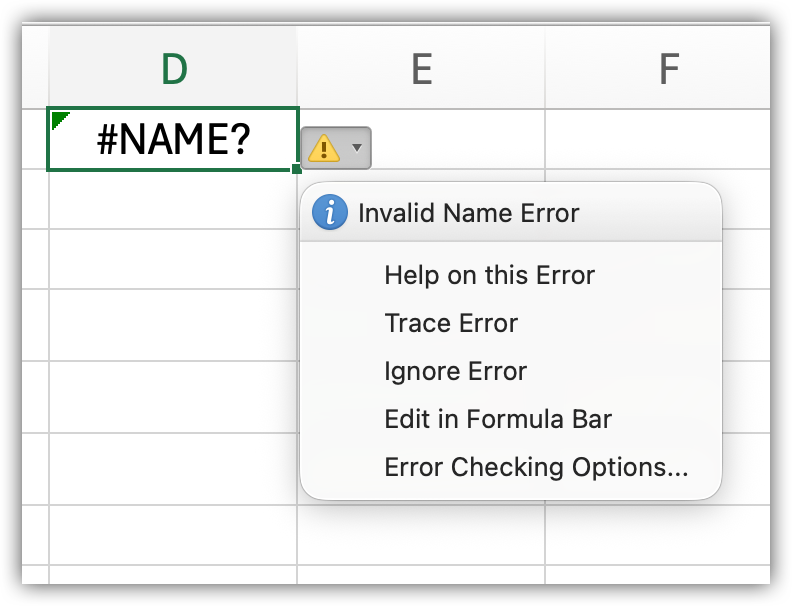
Want an example? Open Excel. In cells A1 through B3, type this little price list:
Bread 3.50
Cheese 7.99
Now in cell D1, type:
=VLOOKUP(“Apple”, A1:B3, 2, FALSE)
If you’ve used Excel formulas before, you know what this does. (Not a formula person? I’m about to explain why those damn formulas have always felt impossible. Spoiler: it wasn’t you.) The formula is basically saying, “find ‘Apple’ in this little price list, and tell me what’s in the second column.” Excel returns 1.20. Every time.
Now type the exact same formula, but leave out one comma:
=VLOOKUP(“Apple” A1:B3, 2, FALSE)
Instead of returning 1.20, Excel throws back an error — #VALUE! or “There’s a problem with this formula.” Same formula. Same data. Same correct intent. You just left out a comma. To you, it’s basically the same thing… you know what you meant. To Excel, the two formulas are completely different things, and it is not in the business of figuring out what you meant.
Computers are rigid. That’s their strength, and that’s their limitation. This is why customer service phone options are annoying, enterprise software is usually bad at anything ambiguous, and every online form you’ve ever filled out reduces you to the options in a dropdown menu.
In December of 1999, we all thought the world might end because some critical computer system would go completely berserk as ‘99 changed to ‘00 because it wouldn’t understand that 99 –> 00, didn’t actually mean we just went back in time 100 years.
Computers don’t do judgment. They never have…
AI - the Yin to the Computer’s Yang
(That sounded way worse than I meant it…)
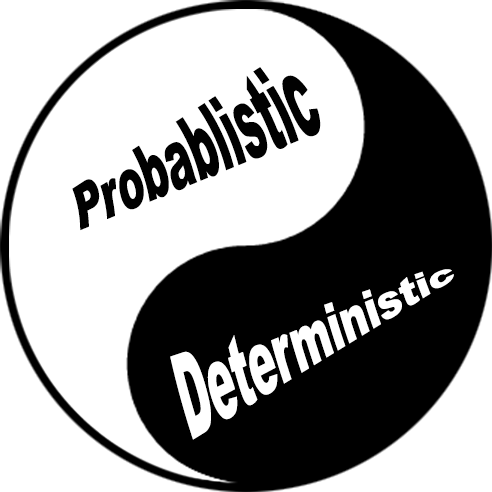
AI — large language models, vision models, neural networks, all of them — are the inverse of a computer… they are probabilistic. They use probability to determine both intent and output. Which is another way of saying they are great at ambiguity. Great at intent. Great at “this is what they meant”. But not so great at rigid things like math, formulas, and even counting.
Where computing is strong, AI is weak. And where computing is weak, AI is strong.
This wasn’t by design… it just kinda worked out that way. We can get into why that is, but that’s another story for another day… Side note: you’re probabilistic too, which might explain why you didn’t naturally take to math either.
The net result - AI isn’t replacing computing. It’s completing it. It’s filling the hole computing has had for eighty years — the ability to deal with the real world, where things are ambiguous, there are typos, rules change depending on the situation, and it’s more likely (i.e. more probable) that the ‘Year’ field is just limited to 2 digits, and we didn’t actually go back in time 100 years. 00 = 2000
Put the two together and something new happens. The AI interprets. The computer executes. AI figures out what you actually want, what context applies, what the judgment call is, then hands it off to the computer to efficiently do the precise thing that follows. And if necessary, the AI interprets the computer’s output before handing it back to you in a way you can understand. That’s effectively what an ’agent’ is, and it’s the concept most AI native products are being built upon right now.
Can You Translate That For Me?
Another thing that just kinda worked out… AI isn’t just good at the human side of this exchange — it’s also exceptional at the computer side. The models you’re typically interacting with are LLMs - Large Language Models, and coding languages are, after all, languages. They have grammar, syntax, idioms, and conveniently, a vast body of online training data. The result: LLMs are natively fluent in programming languages, command-line tools, APIs, SQL, configuration files — all the stuff computers use to talk to themselves. LLMs are the only technology in history that speaks both human and computer at native fluency (which makes them good at writing code to do the math they don’t do well themselves).
AI becomes the natural interpreter between you and the computer. The value of computing has always been gated by how many people could speak its language. Before LLMs, “tell the computer what you want” required a coder, a query writer, or at least someone who could figure out where to put the damn commas in a VLOOKUP formula. With an LLM in between, anyone who can describe what they want in words gets that same access. The pool of people who can put a computer to work went from “people who learned to code” to literally anyone with a phone or a computer.
‘Software’ changes from a rigid system that follows rules and code to a flexible tool that understands your intent and executes it. Most of what you’re used to in software is going to get rebuilt on this foundation. Not overnight, but it will happen faster than you think… we’ll get to why later.
Decisions, Decisions, Decisions…

“The average adult makes approximately 35,000 remotely conscious decisions each day.” I don’t know if that’s true… you can check the source. I don’t really care that much. Whether it’s 35,000, 3,500, or even 350… the point is, it’s a lot. But not every decision is a life-or-death decision — modern humans rarely have to make one of those. Most decisions are relatively benign or inconsequential, but they add up.
The point isn’t to take away every decision. I want to decide whether I’m going to eat a salad or a steak (or more likely a pizza). But there are a lot of decisions I don’t want to deal with. Then there’s decisions I’m not capable or qualified to make. And there’s everything in between.
‘Arriving at a probabilistic outcome’ is just another way of saying ‘deciding’. Think of AI as a decision machine. Feed it the inputs (training data and context) and it spits out decisions, in various forms. String together a bunch of small decisions and you get things like writing code, drafting emails, and reading x-rays. These ‘decision machines’ will crank out decisions the way a computer cranks out calculations.
All Decisions Aren’t Created Equal
Just as most decisions aren’t life-or-death, they don’t all carry the same ‘weight’. To demonstrate this, I’ve grouped decisions into 5 ‘types’ — each with a different level of complexity and a different path for AI involvement.
Type 1 — Speed up the micro-decisions inside your work.
Most of your work isn’t one big decision. It’s a long sequence of small judgment calls. Processing invoices — for each line, does it match the PO? is the tax right? is the vendor on file (“STARBUCKS #1234”, “Starbucks Coffee Co”, and “SBUX”)? Each one is a tiny pause-and-think. You’ve probably already made hundreds of them today.
AI handles each judgment in real time. It’s not that AI thinks faster than you (it probably can’t), but it can do all the peripheral stuff faster — open the file, read the content, update the text, save it. The workflow keeps moving, doesn’t get distracted, doesn’t take lunch. The task doesn’t disappear — the friction does.
Type 2 — Take the decision off your plate entirely.
This is when AI doesn’t just speed you up — it makes the call. You’ve already told it (or it’s figured out) what you’d do, and it just does it.
Your investment portfolio rebalances continuously against rules you set two years ago. You haven’t logged in this year. It’s still right.
It’s not a ‘tool’ you used. It’s a job that’s been done. This will take some trust, some setup, and some calibration, but not that different from training a new assistant or giving your objectives and risk tolerances to a financial advisor.
Type 3 — The decision never has to happen.
This one’s powerful because you don’t notice it. AI doesn’t make the decision for you — it reshapes the environment so the decision-creating event doesn’t happen in the first place.
Not an apples-to-apples comparison, but an analogy to convey the concept - telemarketer calls. Twenty-five years ago the phone rang ten times a day with a number you didn’t recognize. Each time, you had to decide whether or not to answer. Was it a call you needed to answer? Just a telemarketer? You answered, you didn’t answer, you got mad, you hung up. Then “do not call” lists came out and the phone got quiet (well, quieter). An upstream event (the telemarketer deciding they didn’t want to get fined) prevented thousands of downstream decision points (should I answer this?) from ever happening. You didn’t get better at managing what calls to answer, the need for the decision was removed.
Properly structured AI systems could have a similar impact. A decision made upstream surreptitiously improves the downstream environment. The unique thing about Type 3 isn’t that AI did something. It’s that you didn’t notice it doing anything. Things just got better.
Type 4 — The Collaborative Decision.
This is when AI doesn’t take the decision off your plate — it sits at the table with you. The decision still needs your context, your taste, your accountability. But it gets better because the AI brings things to the table you couldn’t bring yourself.
Take a doctor reviewing a tough case. AI surfaces the uncommon-but-fitting diagnoses the doctor wouldn’t have thought of, ranks them by likelihood, lays out which tests would distinguish them. The doctor weighs all of that against what they know about this patient — the things that aren’t in the chart — and decides. Better diagnosis than either would have arrived at alone.
Neither side does this well alone. The decision is jointly arrived at. Most people who work with AI seriously have already settled into this pattern, even if they don’t quite realize it.
Type 5 — The Expert.
This is when AI makes a decision you couldn’t have made yourself, even with all the time in the world. This could take two paths. The first is the expert you couldn’t have hired. Legal, medical, financial planning, specialized engineering — the kind of judgment that used to require a billable professional. The pre-AI version of this decision was “I’ll do my best and hope it’s right” or “I’ll wait until I can afford the consultant.” The AI version is “here’s the answer, here’s the reasoning, here’s what I’d watch out for.”
The second is the superhuman expert. Fraud detection running across billions of transactions in real time, catching patterns no human ever could. These aren’t faster human decisions — they’re decisions a human couldn’t make at all.
Any decision that has to be made today, could be made by AI.
Re-read that for clarity on what I’m saying. The key word is ‘could.’ I’m not implying that all decisions should be made by AI, but I am implying that AI is currently good enough to make most of them today, if given the proper context.
Now, you might argue that AI is not actually ‘making a decision’. It’s just predicting the most probable response based on the context and its training data, and I might concede that point. But I might counter-argue that this might not be that different from the way you make decisions, and further argue that we might just be debating semantics… hypothetically.
The Models are Already Good Enough

Seemingly every month, one of the leading AI labs releases a new model that’s the “the best model in the world!” And for a few weeks, it probably is. But the reality is, it doesn’t matter that much. The models were good enough for most things 2-3 generations ago, and if model capability froze today — i.e. no model ever got smarter than what you can use right now — we’d still be looking at a decade of transformation.
The iPhone was released in 2007. The second version, the iPhone 3G, came a year later. It came with a few key improvements (3G networking, GPS, and the launch of the App Store) that unlocked nearly everything that followed. If the phone hardware froze at the iPhone 3G, and nothing changed for the next ten years (same chip, same modem, same screen, etc.), the functionality that made it so useful: Maps, Music, Messaging, Photos, Banking, Retail, Transportation, Social Media, Dating, etc. all would have still been possible. I think my brother personally ran this experiment by keeping his first iPhone for nearly a decade Contrary to what Apple’s marketing department told you (every year), the chip wasn’t the story. What got built on top of the chip was the story. The App Store was probably the most important release Apple has made to date, since the launch of the iPhone itself.
Most models introduced in the past year could easily make the Type 1 and Type 2 decisions, and if given the proper context and supporting structures, likely the Type 3 decisions too. Frontier LLMs are commonly rated as having IQs in excess of 130 (that’s in the 98th percentile of the human population) with some newer models having IQs in the 150s (99.96th percentile). Don’t trust the scoring methodology?… Fine, I’ll spot you 15 IQ points (which is a lot) and we’ll say they’re really only 115 - 135. That still puts them solidly in the range of the average accountant, engineer, lawyer, or doctor. The limitation is no longer in the intelligence of the model. It’s in the context, tooling, and integration layers. In other words, teeing up the decisions so AI can make them.
Sure, models will improve, but they don’t need to. They’re good enough now. The most useful model improvements likely won’t be smarter LLMs that know everything. They’ll either be smaller models that can live on a device (like a phone or a robot) and quickly do things without an internet connection, or domain-specific models with limited expertise trained to do very specific things.
You don’t go to your cardiologist for advice on that popping sound in your knee, and certainly not for tax advice or a lasagna recipe. Domain-specific models are your ‘specialists’. They won’t give you recipes, rewrite your emails, or make funny images for you to post on Instagram. In fact they may only do one thing — read X-rays, inspect infrastructure, forecast hurricanes, fold proteins, navigate robots around people — but they will do that one thing really well.
If capability isn’t the bottleneck, then what is?
Into the Deep End… with No Water Wings.

If all this is true — the ‘demo’ knocked our socks off, AI is the missing piece of computing, and most decisions could already be made by AI today — then why doesn’t it work? Why is our real experience sometimes underwhelming at best? Fair question. And the answer lies in a paradox…
When most people open ChatGPT (Claude, Gemini, Grok, whatever…), they’re not asking it to make faster micro-decisions inside their workflow (Type 1). They’re not delegating a defined task (Type 2). They’re not letting it reshape their environment (Type 3). They’re going straight to Types 4 and 5 — they’re asking for advice, asking for expertise, asking it to think through something with them.
“Help me figure out how to phrase this email to my boss.“ That’s Type 4 collaboration.
“What are the tax implications of converting my LLC to an S-corp?“ Type 5 expertise.
“Read this contract and tell me what I should worry about.“ Type 5.
“Is this rash something I need to see a doctor about?“ Type 5 and yes!
These are actually the most demanding uses of AI. They require deep context, specialized knowledge, and judgment under uncertainty. Most people are running them with little context (the AI knows next to nothing about you or your situation), no specialization (it’s drawing on general training data), and the most barren interface possible (a chat window with no memory and no integration). It’s like you dove head first into the deep end and didn’t think to ask, ”Do I know how to swim?…”
A more accurate analogy might be, you walked into the gym, picked up the heaviest weight in the rack, used terrible form, still managed to somehow lift the weight, got a little sore later, maybe tweaked your back, then said… “Working out isn’t for me.” It’s not your fault really. You were thrown the keys to the gym with no training, no warning, no three-page waiver informing you that weight training can be inherently dangerous and may cause injury if performed improperly.
Same use case, different setup.
Open ChatGPT (or your AI tool of choice) tell it to “draft a Q3 plan for my team.” Depending on what it already knows about you, you may get a decent outline. It may ask some questions first, then it will likely give you something. It will probably sound good, but as you look at it more closely, it’s pretty generic and not really that useful.
Now give the same model access to your last four quarterly plans, your team roster, your last six months of meeting notes, your KPIs, your boss’s recent feedback, and the project tracker. What you’ll likely get is specific. It uses the right names. It builds on things you already said. It catches the priority you flagged in March that you’d forgotten. It’s eighty percent of where you’d land yourself, in twenty seconds. Same model. No upgrade. But with context.
The model didn’t get smarter… it got smarter about your situation. That’s what infrastructure provides.
The easier types haven’t reached most people yet.
While people are using AI for the most demanding things and getting varied results, the easier applications — Types 1, 2, and 3 — mostly haven’t shown up in their daily lives yet. Why? Because, paradoxically, the easier use cases are harder to implement. Types 1, 2, and 3 need more infrastructure to be useful.
You could ask pretty much any current LLM to look at your expenditures list and tell you which ones are really just “Starbucks”, and they’ll probably all do a good job with the task. But if it takes you longer to ask the question than it does for you to just answer it yourself, what’s the value?
05-02-2026 AMAZON.COM*4G7H2K9 42.99
05-02-2026 Starbucks Coffee Co 8.50
05-04-2026 WHOLE FOODS #10428 67.43
05-04-2026 SBUX 7.99
05-06-2026 SBUX MOBILE ORDER 6.15
For you to effectively utilize AI for the easier types of decisions, it has to be integrated into what you’re already doing and the tools you’re already using. Not as an add-on, or a chatbot - at its functional core. This takes time.
So most people’s AI experience is to use it for the hardest job (Types 4 and 5) on the weakest setup, while the easier jobs (Types 1, 2, 3) — the ones that would actually change their day — haven’t been built yet.
How do you open this damn thing?

The tin can was patented in 1810. The first can opener, shockingly, didn’t get invented until 1858. Apparently, for almost 50 years, cans were opened with hammers and chisels, or just smashed open. Why didn’t they just invent the can opener first and save everyone five decades of frustration while trying to open their spaghetti-o’s?
When a new technology takes hold, the stuff that grows out of it gets invented along the way — because nobody knew it was needed - until it was (or in some cases, fifty years later).
What do can openers have to do with AI and computing? Maybe nothing? But have you ever tried to open a file that your computer couldn’t open? Trying to smash it open may have entered your mind, but that doesn’t work as well as with computers (does it really work with cans?). Instead of a can opener, maybe you used portable document format… Don’t know what that is?
How about now?
Portable Document Format 
Everybody knows what a PDF is. You get them at work, from your bank, your kid’s school, the IRS (hopefully not). You use them when a document has to look exactly the way you laid it out, no matter what computer opens it… and so any computer can open it (see what I did there?..). But the PDF didn’t exist until 1993. It got invented because of a need nobody had in 1975 — an easy way to electronically send a formatted document from one person to another, so it looks identical on the other end, regardless of the software, the operating system, or the printer.
Email is an even more prominent example. Everyone uses it. You’ve got a Gmail, Your company is on Microsoft Outlook, your dad uses Yahoo, your sister still has her Hotmail account from 1998, and you probably have someone in your circle that, unbeknownst to you (and every rational human), uses an AOL address. And yet they all talk to each other (ok, maybe no one talks to the AOL guy). Send a message from any one of them to any other one, and it just works. Why? Because the people that built email all agreed to use the same set of rules — the same protocols — for how an email gets formatted, addressed, and passed between servers.
These protocols did not exist in 1975. They weren’t in the original plan. There’s nothing special about them. They could’ve been created earlier, but they weren’t, because they were not needed. They got built in the ‘80s because people suddenly needed to send email between different systems, and so somebody had to figure out how.
Email protocols and PDFs are now invisible plumbing. Everybody uses them and nobody really thinks about them. But if you couldn’t open your email and read the documents someone sent you because their system used different protocols and formats than yours did, you might just go back to sending typed letters through the mail.
There are many examples of this: HTTP, HTML, SMS. Wifi, the web browser. You may know what some of these are and may not care what others are, but you use them all… probably daily.
Now ask the same questions about AI.
What are the AI equivalents of email protocols and document formats? How does AI get the right context? How is work handed off — between AI tools, between AI and traditional software, between AI and people? How does accountability get recorded when AI makes a decision? How is trust established? We don’t know yet. The needs will surface, followed by solutions - through use.
What matters isn’t any single piece. It’s the totality. Models plus tooling plus protocols plus applications plus infrastructure, stacked on top of each other, compounding on the same fundamental technology. The value is cumulative. No single layer makes computing useful on its own. No single layer is going to make AI useful on its own either.
We don’t know what those layers are yet because we’re still figuring out the basics of how to use the core technology. We’re in the protocol and tooling phase. A need surfaces because a thousand people hit a wall at the same time. People build things. Run into problems. Solve them. And the next piece is added. That’s how email protocols got built. That’s how PDFs got built. That’s how can openers got built…. and it’s how the AI infrastructure will get built.
The question isn’t ’what can AI do?’. The question is what is the infrastructure, protocols, tooling, and environments needed around and on top of it to allow it to work. What’s the AI equivalent of a PDF? An email protocol? A spreadsheet? A file system? A coding language? An app?…
Perhaps one day we’ll look back at the early days of AI and think “I can’t believe we used to just beat the cans open like that?”
You’re absolutely right! (…and it’s absolutely wrong)

Let’s be honest, AI (LLMs) has some real failure modes. Anyone who’s used it for much at all has experienced some, if not all, of the following:
- It made up a fact, a citation, or a quote, seemingly out of thin air.
- It gave a different answer the second time you asked the same question.
- It forgot what you told it five minutes ago.
- It produced something that just sounds like AI wrote it.
- It tells you how right you are. trust me, you’re not that right all of the time.
- It was completely (though confidently) wrong!
These issues are real. But they’re limitations, not showstoppers. They will be worked around and figured out. Perhaps with model improvements, perhaps with supporting infrastructure, perhaps with something that hasn’t been thought of yet. Some have already improved significantly from just a year ago.
But once again, this is not unprecedented. We’ve gone through ‘growing pains’ with computing and watched as similar limitations got solved — over and over — for the past forty years. Things that were once daily realities of using a computer are now nostalgia. Below is just a short list. How many of these do you remember?
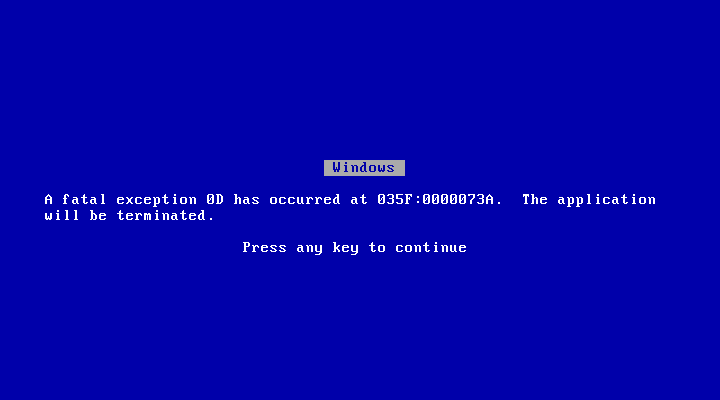
- The Blue Screen of Death. Windows used to just stop and give you that haunting blue screen “An error has occurred…” Sometimes for no discernable reason, other times because you had the audacity to eject the disk before closing the program (how dare you?). You’d have to reboot and you lost everything that wasn’t saved… and it was normal. It was kinda like playing the lottery, but your prize was “start over!“.
- Lost work. You’d type for two hours, the program crashed, the power flickered, the blue screen of death decided to visit again, and your entire document was gone… “When did I last save?“ went flashing through your mind. (I periodically click ‘ctrl + s’ like it’s a nervous tic to this day.) Auto-save came along and fixed it.
- Pop-up ads. You couldn’t visit half the web without ads exploding across your screen, browser hijackers swapping your homepage, the X to close hidden behind another ad. The web used to be annoying. It isn’t anymore (at least not in that way).
- Drivers. You plugged in a printer, or a camera, or a scanner and the computer said “I don’t know what this is?” You went searching through your rag-tag collection of ’computer CDs’ for the driver. You found drivers for all the devices you no longer owned, a CD-rom with photos from your cousin’s wedding, and a Pearl Jam playlist that you burned - but not the CD with the driver you needed… so you gave up. USB + standardized device classes + automatic driver downloads quietly killed this.
- File format. “I can’t open the document you sent?” was a daily email. WordPerfect couldn’t open Word, Lotus 1-2-3 couldn’t open Excel, Mac files broke on PCs. Standardized formats and universal viewers made it disappear.
- Pre-Google search. AltaVista, Lycos, Yahoo’s manually curated directory. You’d search for “weather Chicago” and get back a high-school geography report from 1997, a dead link to a defunct news site, the homepage of a ‘Chicago’ cover band, and a page that was just the word “weather” repeated 500 times for the ranking. PageRank changed the search results rules — relevance came from other pages linking to a page, not from a page stuffing its own keywords. The web became findable overnight.
None of these were solved by faster chips. They were solved by infrastructure, by software, by tools — auto-save layers, ad blockers and browser security, USB and device classes, file standards, search algorithms. Layers built on top of the underlying hardware that enhance its strengths and supplement its shortcomings.
AI’s current failure modes — hallucinations, inconsistency, memory loss, generic output, confidently using the wrong tool — are sitting in exactly the same spot. They aren’t “AI is dumb.” They’re “the layer that handles this hasn’t been built yet.” Validation layers will fix hallucination. Memory layers will fix the forgetting. Orchestration will route the right tasks to the right tools. Stuff we haven’t thought of yet will fix problems we haven’t encountered yet.
And remember, AI is probabilistic - great at language, intent, judgment - bad at math, exact recall, deterministic precision. Many of the “AI failed” stories are a result of trying to use AI for something a computer should do. AI was the wrong tool. Try using a hammer when you need a wrench. You’ll likely just end up with broken bolts. The layer that knows to put down the hammer, pick up the wrench, and then grab the hammer again, hasn’t been fully implemented.
We’ve seen this movie before. These problems will one day be a ’remember when’ story too. The model isn’t the limitation. The infrastructure is.
What Comes Next?
Ok, so what’s next? This is where I tell you what the next iPhone or Google is going to be, right? Sorry to disappoint. If I actually knew that, first I wouldn’t tell you, and I’d probably be too busy building it to have time to write this anyway. (and yes I actually wrote this myself, mostly, so you can blame me if it’s bad).
I realize that attempting to predict the future is likely to make me look pretty stupid in a couple years. But some would say I look pretty stupid now, so maybe I’m already a couple years ahead? Anyway, while I can’t predict the next iPhone, I do have some ideas as to where I think things are heading. So at risk of looking stupider, I’ll give you some of my thoughts…
I’m going to skip all the doomsday Skynet, AI destroys the world stuff. You’ve already read that anyway. Not saying it can’t happen, but I think it’s less likely. I think a far more likely scenario is a ‘bad actor with good AI’ having an outsized impact (‘good’ as in ‘powerful’, not as in ‘benevolent’).
What might things look like once more infrastructure is in place? Let’s return to the 5 types of decisions.
Type 1 (workflow micro-decisions) How is your day impacted when AI is inside the tools you’re using? It’s quietly marking, highlighting, and connecting things as you work. You’re still doing the work. AI is just deciding, in the background, what deserves your attention right now.
I’m not sure exactly how this will get implemented, but I have an idea - and a comparison (of course I do…). Think ’spell/grammar check’ in Word. As you type, the misspelled words have red squiggles under them and the grammatical issues have blue squiggles. You didn’t ask “what’s wrong with this paragraph?” — the answer appears on the page. The really obvious stuff just gets fixed for you. Small decisions were made — this sentence is grammatically incorrect - that word is misspelled. You don’t register them as ‘decisions’, but they help you write a cleaner document. Now imagine that across every tool you use, but smarter and aware of context.
You’re writing an email to a client; instead of identifying typos and grammar mistakes (which it still does), it calls out a phrase that doesn’t match how you’ve talked to that client before — and suggests one that does. When auto-completing a sentence; the suggestion isn’t a generic next-word, it’s drawn from this project, this client, the last six emails on this thread. You drill into a specific issue on a dashboard; every similar issue across the rest of the dashboard lights up so you can see the pattern. When reviewing a contract; clauses that differ from your standard agreement get flagged — not just that they differ, but with a quiet note about why the variation might actually be the right call here, or where your standard language would be wrong for this specific deal. You’re at the beach texting a friend with whom you commonly discuss surfing, you type the letters w-a- and the phone prioritizes ‘water’ and ‘waves’ over ‘want’ or ‘wait’ as the autocomplete suggestion. You’re scanning a report; the numbers that don’t match what you saw last week get gently highlighted.
Each of these are micro-decisions the AI is making for you — this matters, this doesn’t, this matches what you’ve done before, these go together, that’s anomalous — without ever feeling like it’s making a ‘decision’. If you ask the user at the end of the day “what did AI do for you?” the answer is: “nothing really?“ But then turn it off and see how they slow down and get more sloppy. That’s the hallmark of Type 1.
What’s missing today? Depth: AI woven into the tool itself, with access to your specific situation — this client, this project, your usual style. Most tools aren’t there yet. Once they are, you won’t notice it being added. You’ll just notice the tools getting better.
Type 2 (delegation) AI doesn’t just help with a decision — it makes the call. You’ve taught it your preferences and your rules, and it acts.
Expense report reviews - routine reports flow straight through; your manager hasn’t approved one in six months. The two that needed her judgment hit her inbox with a one-line summary of why. A customer asks for a refund on a damaged order — AI checks the order, the policy, the customer’s history, the photo they attached, and issues the refund in twenty seconds. Your flight cancels at 11pm; by morning you’ve got a new flight, a hotel if you needed one, the calendar updated, and a one-line summary on your phone. Nobody on either side had to call anyone.
What Type 2 needs that Type 1 doesn’t: your rules captured somewhere AI can read them (many companies keep them in a manager’s head), permission to act on your behalf, and an audit trail. The harder part is connection — to act, AI has to work across systems that don’t talk to each other, know which one’s the source of truth when they disagree, and follow policies that today are scattered across a config screen, a PDF, and someone’s memory. A few narrow cases already have it — spam filters, expense auto-approval, easy support tickets — because there the rules, the data, and the authority all sit in one place. The general version, stitched across everything you run, isn’t built yet.
Type 3 (decision goes away) AI changes the environment so the downstream decision never even comes up.
A new prescription gets flagged before the pharmacist touches the bottle — AI cross-referenced your full med list, your kidney panel from three months ago, and a known interaction from a study published last spring. The morning where you ended up in the ER doesn’t happen.
A customer-success rep gets a ping at 9am: Acme is at risk — usage flat for three weeks, two support tickets stacked with no resolution, the champion at Acme just updated their LinkedIn -> they left the company. Customer-success rep makes the preemptive call. Acme stays.
An item you order regularly drops to an unusually low price; AI checks your shelf space, your cash position, and your burn rate, and fires off a much larger order than usual. Six months from now you’re not paying double.
Or how about this one… AI watches a hurricane in the Gulf, a war in the Middle East, and the shipping pattern between them, and realizes a component you depend on will be supply-constrained six months out. It locks in an alternate supplier this week. Your competitors are caught short in October. You aren’t.
None of these decisions are especially hard. You could have made every one of them if you’d had the information in front of you at the right time. The decision isn’t the trick. The trick is awareness of your situation, constant monitoring of the signals that matter, and the autonomy to act when the pattern shows up. You could do this, but so could AI — while you’re doing something else, or doing nothing at all.
What Type 3 needs on top of Types 1 and 2: continuous sensing across the signals that matter to you, a long memory of what “normal” looks like for your situation, and the ability to connect signals across domains (the way the hurricane example connects geopolitics to a parts shortage). It’s working in pockets where the investment has been made — banks blocking fraudulent charges before you notice, hospitals catching patient deterioration before it escalates, predictive maintenance preventing factory downtime, cybersecurity tools isolating threats before they exploit. None of it cheap. None of it built overnight.
Type 4 (collaboration) with proper infrastructure looks like the doctor’s case from earlier — but with the AI actually plugged in. Not a cold ChatGPT being asked for differentials in a vacuum. The AI has the patient’s full chart, the hospital’s standards of care, the doctor’s own past cases, and the latest research filtered for relevance. The doctor still decides. But the conversation is now happening between two parties that both know what they’re talking about — not between an expert and a stranger.
What Type 4 needs: deep context, plus enough confidence to push back. An AI that nods agreeably at everything you say isn’t a collaborator — it’s a mirror. Some narrow tools are already close (pair-programming assistants that argue back about your code). Most aren’t.
Type 5 (expert) with infrastructure means the expert you couldn’t have hired finally has access to your situation. Not “here’s general tax advice” — but “here’s the answer for your specific entity structure, your state, your income mix, the cap-ex you ran in Q2, and the carry-forward you forgot about.” Not “here’s what a contract like that usually says” — but “here’s what this contract says, here’s where it deviates from your standard, here’s what to push back on.”
And the superhuman expert? That one’s already partially here. Banks already use fraud detection across billions of transactions in real time. Trading firms do it sub-second. Genomics labs are doing it on protein structures. What’s missing is breadth — the same kind of capability for the rest of the economy, on the rest of our problems.
Most of this probably doesn’t show up as a ‘new product’ — it will steadily get integrated into the software products you use, and you’ll see it in your documents, your inbox, your dashboards, etc. But that’s only half your life. The half you actually move through — your kitchen, your car, your doctor’s office — is about to get the same upgrade.
Smart devices are about to become smart

Every “smart” thing you own right now is actually dumb. Your smart thermostat runs a schedule and has some sensors. Your smart fridge tells you when the door’s open with a sensor and some communication protocol. Your smart TV is a regular TV with apps. “Smart” today is a marketing word for has a chip and an app. They just run on code (i.e. they’re rigid and don’t do judgment or intent).
Truly ‘smart’ means probabilistic decisions in context. It means your thermostat doesn’t run a schedule — it knows your wife came home early, you’ve got the kids tonight, a cold front is moving in, and the house has been running cold all week. So it decides to modify its operating schedule.
And it’s not just the cognitive stuff. It’s the physical decisions humans have always had to make with their own eyes, ears, and hands.
Let’s look at another example… you’re cooking a pizza. How do you know when it’s done? Did you follow the directions exactly? Pre-heat the oven to 375°? Set the timer… and DING! pizza’s done. Perfect every time, right? Probably not. Maybe you’re in a hurry and didn’t quite wait until it was done pre-heating? Maybe your oven runs hot so you set it to 350° instead? But what’s the last thing you do before you decide it’s done? You look at it. Why? Because you know what it looks like when it’s done (or when it’s not done, or over-done). How do you know? Because you’ve probably cooked, and more importantly eaten a pizza many times before. This is all context that you have (that you didn’t even know you had). Your brain applies this automatically. It’s actually pretty amazing when you think about it (because you don’t even have to think about it). But what you’re doing here is learnable and repeatable, given the right context. You learned it…
Now let’s apply this to a smart oven. It’s been given thousands or even millions, of examples of what a done pizza looks like. In effect, it’s got more pizza cooking ‘experience’ than you do (though less pizza eating experience…). Is this pizza done? An oven camera watches, temperature and time are tracked, a sensor picks up the volatile compounds that fire off at the right stage… etc., etc. It pulls the pizza — or pings your phone with a photo and a one-word verdict: ready. Not bad… right? But wait, the oven has never actually eaten a pizza. How does it know that you like the edges crispy and the cheese just past bubbly? It doesn’t… until you tell it. “That pizza was slightly undercooked“, or ”I like my crust more brown“, ”that one was perfect!“. A probabilistic system understands this feedback and can ‘learn’ from it. Maybe it makes a log of every pizza it’s ever made for you and how it turned out, saves a picture of that pizza that you said was ‘perfect’, and creates a routine that always results in your perfect pizza. It can do all these things because it can both use judgment and computing, and apply the additional context you give it.
Ok, so what?
“I don’t want a smart thermostat or a smart oven… I don’t even like pizza.“ - you might say.
To which, I would respond - “What’s wrong with you?! Who doesn’t like pizza????“
But the point is that it can be applied to any scenario that requires judgment. Is this concrete cured? - embedded probes, a vision model reading surface color and hairline cracks, the history of the ambient temperature since the pour, the mix design, and the load it’s going to carry — all of it integrated. It tells you to wait twelve more hours. If you’ve got a deadline, it tells you which cylinder test to run to confirm.
Is the fruit ripe? Is the weld sound? Is the wine ready? Does the crack in the bridge beam need immediate action, further investigation, or is it a non-issue?
Devices are about to acquire something they’ve never had — perceptual judgment. Not more sensors, not more connectivity. Actual judgment. The word “smart” stops meaning connected and starts meaning can decide what it’s looking at. And the impact isn’t confined to one industry — it’s anything that ever needed an eye, an ear, or a feel for “what’s going on here.” The same shift is coming for the software running everything else.
Off with Their Heads!

Most of the software you are familiar with has a face — buttons, menus, screens, things you click on. This is called the “User Interface” or “UI” (Sometimes called a UX for User Experience. Don’t ask me the difference between a “UI” and a “UX”. I haven’t figured it out…) The UI is all the stuff you see and interact with when you open an app or a webpage: icons, dropdowns, the “Submit” button, the Home Screen, etc. Software has a UI for the same reason a car has a steering wheel — so you can drive it. But also like steering wheels, you’re going to start seeing fewer and fewer of them in the wild…
Not all software has a face, or more accurately a ‘head’. A lot of software is considered ‘headless’… which just means it has no UI. It doesn’t need one because people don’t interact directly with it, other computers and software do. When you tap your phone to pay for coffee, you’re not opening your bank app and directing it to pay the merchant’s bank from your account. Instead, there’s a service called Stripe (or one of its competitors) running silently between your card and the merchant’s bank. Twilio sends the text from your dentist’s office confirming tomorrow’s appointment. The spam filter that pulled 47 emails out of your inbox before you woke up. The fraud detection software running on every credit card swipe. The system that delivered the YouTube video to your screen. This is all software, and it’s mostly all headless. It’s everywhere. You just don’t see it. You don’t need to. But you probably ‘use’ more headless software daily than software with a UI.
AI blurs the lines on who, or what, the ‘user’ is.
Have you ever used an app where you can’t figure out how to do something? What about a website where you can’t find what you’re looking for? A well-designed UI clears a lot of this up, and a poorly-designed UI makes it almost impossible to use the software. You don’t need a steering wheel if a human isn’t steering the car, and you don’t need UI if a human isn’t steering the software. The whole UI/UX industry was created to solve one problem:
’Normal’ humans don’t speak computer language, and computers don’t understand human language.
The mouse. The keyboard. The trackpad. The touchscreen. Icons, menus, buttons, drop-downs, scrollbars, windows. The trash can on your desktop and the little floppy-disk “save” icon. Entire coding languages like HTML, Java, and JavaScript. All were invented to bridge the gap between you and the machine. AI, being fluent in both languages, becomes the bridge, and the UI/UX industry, creative and effective though it is, largely becomes unnecessary.
If you were going to ask someone to perform a task for you, how would you do it? (This is not a trick question.) Let me tell you how you likely would NOT do it. You wouldn’t use a bunch of symbols, menus, icons, and vague commands like ‘start’, ‘search’, or ‘submit’. You would just tell them what you wanted them to do.
“Give me a status update on the ACME project for tomorrow morning’s meeting.”
You assume they know: what the ACME project refers to, what kind of status update you want, what meeting you’re talking about, when it is, where to find the information, what format you want the update to be, and how to give it to you. And if they’re not clear on anything, they’ll likely ask you. A computer may have access to the information that you want, but it doesn’t really know any of this stuff. In order to provide you the information, the computer has to run a pre-configured set of instructions (code). The UI forces you to define this task in a way that the computer can understand and execute it… no ambiguity or judgment involved. The problem is, any variation that’s not pre-defined (written into the code) isn’t an option, so you won’t see it in that pesky dropdown menu… The report you’ll get is likely a bunch of data: numbers, dates, dollar amounts, etc. And you, or someone, will need to interpret it.
Replace the UI with AI and these restrictions are removed. If your AI is familiar with both your software and your business (context, memory, and integration), you just tell it what you want, and it defines the task as an input to the computer, the computer runs the task(s) and the AI interprets the computer’s output.
“Give me a status update on the ACME project for tomorrow morning’s meeting.”
AI tells the computer (software) what to do, gets the results, looks it over, and gives you the update. And if it’s not sure ‘what kind of status update you want’?… It can just ask you. The need for the steering wheel goes away.
Since almost anything you want a computer to do can be described in words, this same approach could be applied to almost anything. I’m sure there will still be some need for icons, pointing and clicking, but most of it will go away and be replaced by text, voice, photos, even videos.
Your AI Contractor
So to summarize… software with a UI –> for humans; headless software –> for computers. Nice and simple… kinda. Except, there’s also a gray area called ‘orchestration’ that’s a mix of both. Basically, when and how to do what. Sometimes you tell the software directly through a UI - run this report, open this page. Sometimes the headless software knows what to do - after every transaction, run the fraud detection software. Sometimes it’s a combination of both… ’run the outstanding issues report and email it every morning at 9:00’. You, via the UI, set up the report, define what it should include, set when to run it, and where to send it; then the headless software takes those pieces and runs all the pre-defined ‘services’ to execute it. Almost all software has some kind of orchestration. Some are more automated (less user driven) and some are primarily user driven (they only do something when you click). The UI is half the story. The orchestration is the other half.
Imagine hiring a contractor to remodel your kitchen. The contractor is your single point of contact… the ‘orchestrator’. They schedule the plumber, the electrician, the cabinet guy, the tile guy. They manage when each one shows up, validate the work, coordinate the sequencing and hand off between specialists. In theory you could do all of this yourself — find each subcontractor, schedule them, manage them, check their work — and if you have the time and the know-how, you might. You’d likely hire subcontractors for the things that actually require specialty. You might choose to do simple stuff (paint a wall, swap a fixture) yourself, rather than hire someone to do it.
In your current software tools, the orchestration layer is the contractor and its data, services, reports, etc. are the subcontractors. You interact directly with the contractor through the UI. But this comes with a set of problems: you don’t actually speak the same language as your contractor, he’s very rigid, and if there’s any ambiguity, well that’s just too bad, you get what you get. He always uses the same cabinet guy, so those are the cabinets you’re going to get. You told him you wanted aqua walls, but he understood that to mean blue. And you didn’t specifically mention that you wanted an outlet for the refrigerator in the opening where the refrigerator goes. Was he supposed to read your mind? If you want to plug in your fridge, you better tell him to install an outlet.
In the AI world, AI becomes the contractor. It can do the orchestrating. Apps and software either become subcontractors (specialists AI calls when it needs them) or they get bypassed entirely (tasks the AI can do on its own). Now you have a contractor that speaks your language, is flexible, deals well with ambiguity, and understood what you meant when you said the kitchen should be functional. Your new contractor can also communicate well with all the subcontractors (software and services). It knows to tell the electrician to add an outlet where the fridge is going to go, and the painter needs to verify the paint sample because aqua is subjective. It can use specialists when it needs to, but it can also do plenty of the work itself, so it may decide it’s quicker to not use a painter and just paint the wall itself. - Why use a marketing tool if AI can compose and send the emails itself? Why use a database app if AI can just pull the answer from the data directly? Why use a scheduling app if AI can find a time and book the meeting without one? AI is a capable contractor.
And this contractor works with anyone… He doesn’t just use his own team and the same subcontractors every time. If there’s a unique type of flooring that you want, and his regular flooring guy can’t do it? No problem, he will find the one flooring sub in town that does it, and hire them for this project. This is where the domains really start to blur. Your CRM, ERP, Accounting, and HR programs all have things they do well… and things that they don’t do well. And none of them work well together. It’s like you’ve got four contractors, all wanting to remodel your kitchen, but none of them really want to do all of it, but they also don’t really want to deal with other contractors either… or even you, if they can avoid it.
The bar for what software justifies existing as a service (and worth paying for) goes up. In a world where AI is the capable orchestrator, software has to provide something AI can’t easily do itself. Things like:
- Network effects (Stripe has relationships with every bank in the world — AI can’t replicate that overnight).
- Regulated access (certifications, licenses, audited security AI can’t fake). Specialized data (proprietary signals or models that aren’t on the open web).
- Physical-world integration (hardware, sensors, real-world operations).
- Speed at scale (optimizations AI can’t match by writing code on the fly).
- Specialized or institutional knowledge that’s not widely distributed. Some sort of specialty or moat that justifies your existence.
A lot of existing software doesn’t survive in its current form. Pure-code services. Wrappers around things AI can write itself. Forms with logic behind them. Apps whose only value was “we built the buttons.” Existing software with a chatbot just bolted on. These all die — AI isn’t going to use a service to do something it can do faster by writing and executing the code itself.
What replaces them is a new form of software. Built for AI to use, not for humans to click. Tools that used to live inside a “program” get unbundled into stand-alone capabilities AI calls when it needs them. Pricing structures follow: licenses and seat fees give way to per-use, throughput-based, or even crypto micro-transactions for one-off uses. You can’t charge per seat if there are no ‘seats’. The change will get applied across almost all software categories — expense systems, payroll, project trackers, inventory, marketing automation. How they shake out will split four ways. Some survive on real specialty. Some become pay-per-use services. Some get hollowed out, kept around for compliance but increasingly bypassed. Some disappear entirely. And new categories appear that don’t even make sense yet — services built for AI to use, things no human would ever want to “open.”
The implication for software companies: your product isn’t the UI anymore. It’s whatever specialty justifies your existence in an AI-orchestrated world. And your ecosystem is no longer your moat. When data and processes become exposed and unbundled, the value of your tools and services change. Your customers still do the work the software was built for, but they’re not the ones clicking the buttons anymore — AI is. So you change who you’re building for.
The same shift is about to hit the work that isn’t software at all. The ‘iPhone of AI’ — the creation that makes AI useful for everyone — may not even be a device. It may just be the connective tissue — AI plus a fabric of headless services — AI doing the orchestration the apps used to do, and you only see the result. Or maybe it is a device, just not one that fits in your pocket.
Your Roomba gets friends.
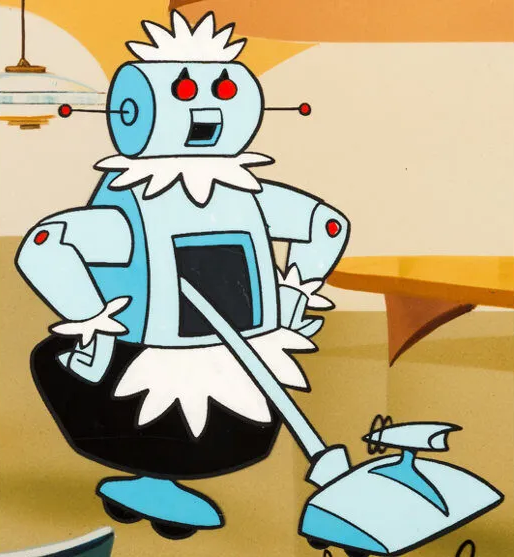
Is a robot a device? Maybe a stretch. But they’re coming, in all shapes and sizes.
You’ve probably seen videos of robots dancing, folding laundry, and sorting packages, or dystopian Chinese attack dog robots, maybe you’ve personally observed those weird robots in the airport that are collecting wheelchairs or something (who knows what they’re doing?). What was a curiosity ten years ago is a viable, though still expensive, product today. Currently still rare, you will start to see them everywhere.
The subject of robots could fill an entire article by itself, but this one is already too long. I’m surprised you’re even still reading this? Maybe I’ll write a separate piece on robots later? But there are a few ideas I want to convey here, and they’re more of the same. I’ll try to be brief.
Much like with computing, the hardware robots use isn’t really new. What’s new is what that hardware can do now, that it couldn’t do before. AI gives robots four capabilities they didn’t previously have:
- Sight. Traditional robots may have had a vague awareness of their surroundings but they didn’t really have vision. Through the use of cameras and sensors, they could detect a part at coordinate X,Y; measure distances and navigate a known path and detect obstacles, branch on a threshold, etc. They could operate within an expected environment, and maybe sense when something was off — but they couldn’t see. Imagine walking around your living room in the dark. You kinda know what’s there and where everything should be. You can feel for furniture and walls, get around because you know the layout — but if somebody re-arranges the furniture, or your kid leaves a toy on the floor, you might be in trouble. If it’s someone else’s living room… you’re frozen. Turn on the lights and now you have no problem noticing the toy on the floor and maybe even picking it up… Vision models are like turning the lights on for a robot. A robot can now see its environment…find the cup on the counter, judge depth, tell a tool from a table, recognize the difference between a person and a coat rack, and notice that toy your kid left on the floor. Its world doesn’t have to be perfectly staged anymore (i.e. rigid).
- Language. A robot can be told what to do in plain English. “Bring me the screwdriver from the toolbox.” The same tech that lets you talk to ChatGPT lets a robot understand what you want, without anyone writing a routine for that specific task… and it can communicate back to you.
- Understanding. A robot can have general ‘knowledge’ and context. Foundation models trained on huge amounts of physical and visual data give it a working understanding of the world before it ever sets foot (wheel?) in that world. Domain-specific models will provide advanced knowledge of the environment or roles it will operate in. A household robot not only knows what a kitchen is, but also what “clean up” means in this context, and which object is right for which job. A factory robot, or surgical robot, or airport robot all get their own specialized knowledge for their environments. Pre-AI, every situation needed explicit programming. AI adds general understanding.
- “Learning.” This falls into two groups:
- Individual: your instructions and preferences get saved — how you like a shirt folded, what “clean up” means in your kitchen, which bin gets the soda cans. Cheap ‘learning’, but can be effective.
- Hive: every robot’s experience can feed back into the shared model. Tesla’s self-driving cars are the real-world example — every car on the road contributes to the data, and every car eventually gets the improvement. One robot trips on a doorstep in Cleveland; the failure gets logged, an engineer (or another AI system) traces the failure, the fix gets folded into the next training cycle, and the whole fleet gets it on the next software update. The cycle is days to weeks, and tightening. Every robot ‘learns’ from the failures, and successes, of every other robot.
Before AI, a robot was a precise machine executing a script (think physical software). With AI, it’s an agent executing intent in an environment it can see and make sense of. It’s the same story the rest of this article is describing — but for hands instead of words. The impact of this shift is HUGE. Any physical task will be able to be performed by a robot. I think people are underestimating this.
Humanoid robots (robots that sorta look like people… in a C-3PO kinda way) get all the press. And because the physical world was built for humans, humanoid robots can most easily adjust to the physical world as it is. But the step change will occur when things start getting built with robots in mind, and specifically for robots. Things will no longer need to be designed for human interaction (think removing the ‘steering wheel’, but on everything). The human body is an amazing hyper-cross-functional structure (the original Swiss Army knife), but it isn’t the ideal form for every task. There’s a reason your Roomba is shaped like a giant hockey puck and not like Rosie the Robot. Most actual work is likely to get done by boring single-purpose machines — warehouse pickers, dish-loaders, delivery rovers, inspection drones.
The break dancing humanoid is the eye-catching prototype, but specialized robots are the more practical answer for many applications. ‘Head and shoulders, knees and toes…’ both a catchy children’s song, and complex, expensive components that will be eliminated when not necessary.
And it’s going to happen faster than you think…

When I say we’re in 1975, don’t take that as me saying you have decades to figure this out. You don’t. Not even close.
The 1975-to-2020 arc of computing took about 45 years. AI’s version of that is going to compress… hard… for several reasons:
- The infrastructure already exists. Cloud, networks, devices, payments, identity, video streaming — all of it, already built. AI is plugging into a mature digital infrastructure. Computing had to develop this from scratch.
- The money was there from day one. Computing in 1950 had no consumer market. AI has Fortune 500 budgets, venture capital, and government spending flooding in from month one.
- Distribution is solved. Four billion smartphones already on the planet. The App Store exists. The browser exists. Anything new ships to everyone on day one.
- The technical competency is orders of magnitude bigger. Millions of developers worldwide. In 1950, the entire field of computer scientists would have fit in a single hotel.
- This is the biggest one — AI accelerates its own development. Developers are using AI to create AI. Researchers are using AI to design better AI. Tools that would have taken years are getting built in weeks. And at some point (if it’s not already happening) it will be self-improving.
Add it all up and the curve compresses. It won’t take 45 years for AI to go from 1975 to 2020. It’ll take about 10 years, probably less.
…but not as fast as I think.

I think less than 10 years, but I might be wrong for several reasons. The technology will be ready before the world is. And that gap is going to be messy, chaotic, and somewhat predictable — because it involves humans, which are largely messy, chaotic, and somewhat predictable. And the things that will slow it all down? Also predictable.
Psychological Constraints
Change
Change is generally hard for most people. Integrating new ideas, methods, and tools into your daily life will take time. Changing how work gets done is often harder. Your company may want to switch to AI-driven operations because the CEO saw a demo… but it often can’t. Switching systems and processes isn’t easy. And most aren’t ready for it. Undocumented workflows have to be documented, then redesigned. Edge cases will be discovered (probably the hard way). The software may play well together now, but the data and processes built into the software were never meant to interact with other software, so gaps exist. Then there’s the realization that some knowledge only lives in someone’s head and the AI tools can’t access it. Staff will need retraining and a lot of shuffling around based on new needs. Figuring out which jobs need a person, and who can fill those roles… It all gets messy. And some will avoid it.
“Change happens when the pain of staying the same is greater than the pain of change” - Tony Robbins
I can’t believe I just quoted Tony Robbins…
And then there’s the political side. When a technology displaces jobs at this speed, governments will react. Maybe not well, probably not always rationally, but they will react. The EU took four years just to pass an AI Act. Every country will have its version. Some will accelerate adoption. Some will slow it to a crawl.
Trust
The internet was technically ready by the mid to late 90s. Broadband existed. E-commerce worked. Online banking was possible. But it took another 20 years before your mom stopped being afraid to put her credit card on a website (my mom still won’t). Why? Trust. People grant it slowly and revoke it instantly — and that’s just with other people.
AI is already running into a trust wall. Some trust it immediately because it sounds smart (bad idea), but many will be slow to trust it (better idea). High trust systems will be S - L - O - W to integrate it fully. (…and I have no problem with this)
Healthcare systems run on software from 20 years ago (at best) — and they run on it because it’s been certified, audited, and validated to a standard that takes years to achieve. You can’t just swap in an AI layer because it’s better. You have to prove it’s better, to regulators who move at the speed of legislation, not innovation. Same with finance. Same with aviation. Same with anything where ’99% accurate!’ isn’t good marketing, it’s a lawsuit.
Fear
There will be horror stories that scare people. Somebody will do something stupid — roll out a process that wasn’t thoroughly tested, didn’t have the proper guardrails or blast radius containment, grants authority at the wrong level, uses AI in a way that wasn’t a good fit, or didn’t have the buy-in from the team that supported it (likely some combination thereof) — and it will fail miserably. Everyone will hear about it. Then someone else will do it again the next month.
Physical Constraints
Infrastructure and Supply
In addition to the psychological constraints there are some physical ones. AI runs on two things: advanced semi-conductors (microchips) and the electricity to power them. When everyone is reaching for these resources at the same time, there will be a supply issue.
Robots are physical. You have to build them… one at a time. You can’t just roll out a fleet of robots to the world overnight like a new AI model or a software release. And they require parts — those damn microchips again, but also batteries, servos, other things that have to be sourced or created. There’s also changes to the infrastructure necessary to fully take advantage of task-specific robots.
What I think likely happens? The technology itself — the models, the tools, the protocols, the infrastructure — are in place by 2030. Everything needed to build the AI equivalent of today’s computing ecosystem functionally exists by then. The world absorbs it a bit more slowly, but the transition is by no means slow. Regulated industries may lag by a few years. Developing economies lag further (but actually spring forward faster, in another seeming paradox). Full immersion — the moment where AI is as normal as electricity (or a cell phone) — mid-2030s. Robots will take more time. The robots are coming, but a little more slowly and steadily. Though they may actually be more impactful when they finally arrive.
AI’s version of the 1975-to-2020 computing arc will take 45 10-15 years. What happens during, and after, this period is a bit more difficult to foresee. However, I think it’s safe to predict some massive shake-ups and growing pains will occur. The technology is going to be here before most people expect it. Those that are ‘ready’ will more easily make the transition when it arrives, but even the most prepared will get a few scrapes and bruises along the way. The totally unprepared may not realize what’s happening until it’s too late to do anything about it.
The starting gun has already gone off.
So what now?

Hopefully you now know a little more about what has happened, is happening, and will likely happen. You know we’re early. The technology that’s going to reshape everything is already here, but it’s not yet plugged into the systems and infrastructure that will make it useful. You also know it’s going to accelerate — the curve from “AI exists” to “AI is everywhere” is years, not decades.
So what do you do?
Ignore it? - Call it hype, and hope you’re right.
Scramble? - Just try to do something.
Prepare and adopt… - Implement it as it makes sense for your situation.
What does ‘prepare and adopt’ look like? It really kind of depends on your situation, but it isn’t buying every AI tool that launches. It’s probably more like getting your house in order so that when the infrastructure arrives, you’re ready to plug it in. The probabilistic nature of AI means that it is effectively a decision machine. Rather than thinking in terms of tools and tech, I would challenge you to think in terms of decisions. What decisions are made? What information (or context) is required to make them? How are they validated or approved? What level of damage is done if they’re wrong? This is how you plug in the machine. Start with low hanging fruit and grow up and out.
Some high level tasks:
- Get your data clean, organized, and connected. Type 1 — AI inside your tools — starts with AI being able to see across the systems where your work actually happens. Companies whose data is siloed and messy are years behind companies whose data is in order. The connector layer is being built right now; what it connects to is your data. Another irony is that AI can be an excellent tool to help you prepare your data for AI…
- Start writing down how decisions actually get made. Type 2 — AI making the call — needs your rules captured somewhere AI can read them. If much of your business runs on rules that live in someone’s head: that manager’s institutional knowledge, that customer success rep’s instinct, that AP clerk’s “this looks weird.” Capture them. Document the policies, but just as importantly, the ‘judgment’ calls often go undocumented. Start breaking them down to repeatable ‘systems’, identify the exceptions and escalation paths. Don’t let this knowledge walk out the door with retirement…
- Start instrumenting. Type 3 — decisions that don’t need to be made — might need sensing across your operations so AI can see drift, anomalies, and patterns. The data you’re capturing today is what trains the predictive layer in two years. If you’re not capturing it, you’re not getting it.
- Get your hands dirty with the tools. Don’t wait for the polished version. The people who have working intuition for AI today — what it’s good at, what it isn’t, what kind of context it needs — are the ones who’ll architect the systems that come next. You can’t outsource that intuition. You build it by using.
The computing revolution took decades to develop. You had time to absorb it and adapt slowly. The early movers in computing had an advantage, but it wasn’t so great that late adopters couldn’t catch up. AI may not work that way. Things will change fast.
It’s 1975 for AI right now… but it will be 2030 soon. Are you ready preparing?
I’ve put a lot of thought into this. Maybe you have too. Maybe this gets you started thinking about it. Either way — if you want to work through it with someone, I’m interested…